Scaling
KEDA and Descheduler: Two-Tier Autoscaling on Bare Metal
KEDA event-driven autoscaling on Kubernetes scales pods to zero on queue depth; the descheduler bin-packs survivors to reclaim bare-metal nodes — no Karpenter.
Autoscaling on a hyperscaler is two moves that feel like one. The HorizontalPodAutoscaler adds pods when CPU climbs, and when the pods no longer fit, Karpenter or the Cluster Autoscaler calls the provider's API and a new instance materializes minutes later. Capacity is a credit card: you spend it when you need it and stop paying when you scale in. Move that workload into your own rack and the second move evaporates. There is no API that conjures a server; your node pool is the machines you racked, and it does not grow because a pod is Pending. The elasticity you took for granted was never a Kubernetes feature — it was a billing relationship with someone else's data center.
Self-hosted platforms must re-derive autoscaling from first principles. You cannot provision nodes on demand, so the goal shifts from "buy capacity when busy" to "use fixed capacity densely, and free whole machines when you can." That produces a two-tier design with no cloud equivalent: KEDA drives pod elasticity — including the scale-to-zero that idle GPUs make non-negotiable — and the descheduler bin-packs survivors so emptied machines can power down or sit in reserve. This article wires both for production, including the seams.
It is a companion to the cloud repatriation playbook — repatriating compute is the first half; getting elastic behavior out of inelastic hardware is the half that decides whether the economics work. It assumes the self-hosted observability stack is already in place, because both tiers are only as good as the metrics that drive them.
Why Cloud Autoscaling Doesn't Port to Bare Metal
Karpenter is a superb piece of engineering aimed at a problem you no longer have. Its job is to watch for unschedulable pods and provision right-sized cloud instances directly from the provider's compute API — choosing instance types, spot versus on-demand, and zones, then terminating them when they drain. Every one of those verbs is a call into AWS, Azure, or GCP, and on bare metal there is nothing on the other end of that call. Your capacity is a countable set of physical machines with a fixed aggregate of CPU, memory, and GPUs, and the only ways to change it are a purchase order and a rack visit. Provisioner-style autoscalers are therefore not "harder" on-premises; they are category-inapplicable.
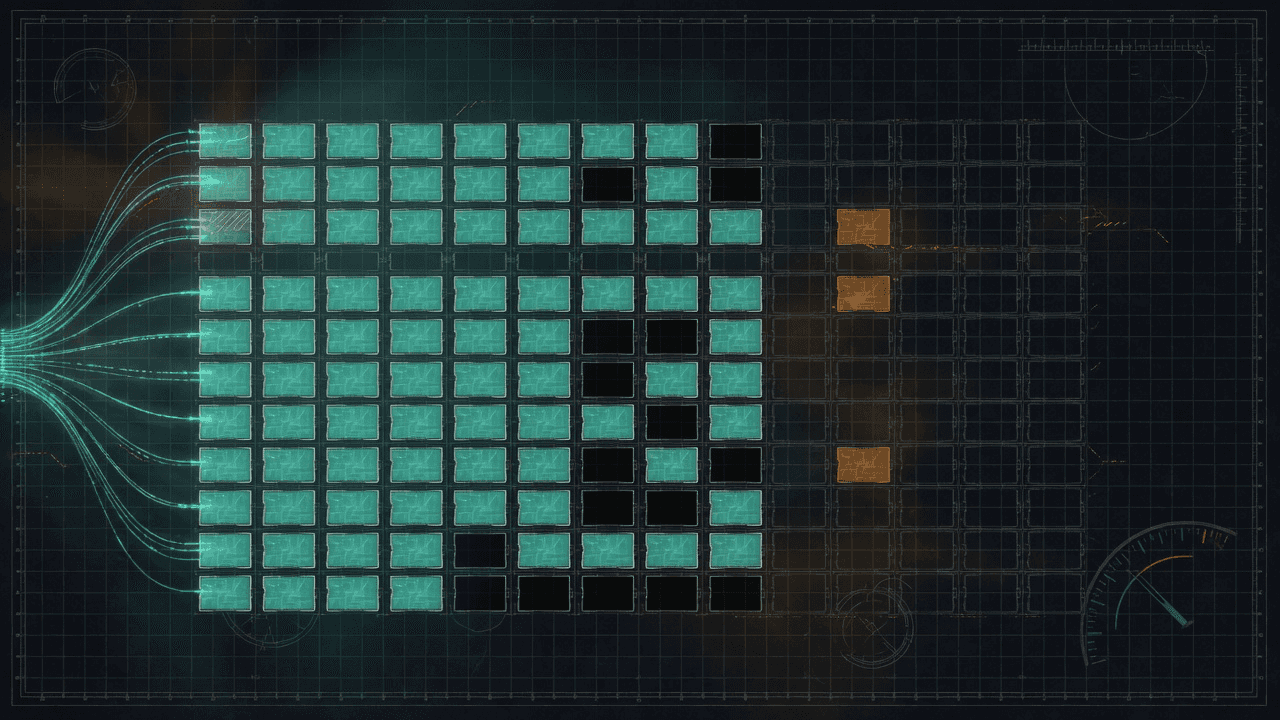
What remains, and what you fully control, is placement and pod count. Bare-metal autoscaling is two axes on a constant pool: how many pod replicas exist (tracking real demand, not CPU), and how tightly they pack onto nodes (which decides how much hardware is stranded as fragmentation). Cloud lets you buy out of bad packing; you cannot, so you must solve both — that is what makes a fixed pool behave elastically. The diagram contrasts the cloud model with its two-tier replacement.
Tier One: KEDA and the 0↔1 Problem HPA Can't Solve
The built-in HorizontalPodAutoscaler has a hard floor of one replica and a native vocabulary of CPU and memory — the wrong instrument for event-driven work. A consumer draining a Kafka topic, a batch of image renders, or an LLM inference server does not get busy because its CPU rose; it gets busy because work arrived, and CPU only climbs *after* the backlog has formed. KEDA, a CNCF-graduated project since 2023 with more than sixty built-in scalers, closes both gaps: it scales on the arrival signal itself — Kafka consumer lag, RabbitMQ queue length, a Prometheus query, a cron window — and it scales to and from zero, which the HPA cannot do alone.
The mechanism explains every quirk that follows. KEDA does not replace the HPA; it feeds it. From one replica upward, KEDA runs a metrics adapter and a generated HPA does the arithmetic exactly as it always has. The boundary at zero is the special case: the KEDA operator itself handles the 0 → 1 activation and 1 → 0 deactivation, because an HPA structurally cannot reason about zero. So a ScaledObject is two controllers cooperating — the operator as the on/off switch, the HPA as the volume knob. A Kafka-lag ScaledObject for a self-managed event backbone looks like this:
apiVersion: keda.sh/v1alpha1
kind: ScaledObject
metadata:
  name: orders-consumer
  namespace: ingest
spec:
  scaleTargetRef:
    name: orders-consumer          # the Deployment to scale
  minReplicaCount: 0               # scale-to-zero: no idle consumers
  maxReplicaCount: 40
  cooldownPeriod: 120              # wait 120s after last active trigger before 1 -> 0
  pollingInterval: 15             # how often KEDA evaluates the trigger
  triggers:
    - type: kafka
      metadata:
        bootstrapServers: redpanda.ingest.svc:9093
        consumerGroup: orders
        topic: orders
        lagThreshold: "500"        # target: ~500 lagging msgs per replica (the HPA knob)
activationLagThreshold: "50" # 0 -> 1 only once lag exceeds 50 (the operator knob)Two fields carry the whole scale-to-zero contract, and conflating them is the most common KEDA mistake. lagThreshold is the HPA's target: with a value of 500 and 4,000 lagging messages, the HPA wants eight replicas. activationLagThreshold is a separate gate the operator checks first, and it wins ties — set it to 50 and the deployment stays at zero until lag crosses 50, even though the HPA's math would already justify a replica. That split encodes the exact policy expensive workloads need: do not wake for trivial trickles, but once you wake, scale aggressively.
Scale-to-Zero on Expensive GPUs: The Sharpest Case
The economics of scale-to-zero are marginal for a stateless web service and decisive for a GPU. A single owned H100-class accelerator is tens of thousands of dollars of capital, and an inference pod holding one idle overnight is that capital earning nothing while still drawing power and heat. You cannot delete the machine as you would a cloud instance, but you can free the GPU — evict the idle pod so the card is available for a different job, and if nothing needs it, let the node fall idle for the descheduler and power management to handle. This is why the CNCF community spent early 2026 building KEDA external scalers for GPU-backed inference: the idle-GPU bill is the sharpest current driver of event-driven autoscaling.
A self-hosted vLLM inference server is the canonical target. Drive it from an external queue that still exists at zero replicas, keep the floor at zero, and set a cooldown long enough to absorb bursts without thrashing a slow-loading model:
apiVersion: keda.sh/v1alpha1
kind: ScaledObject
metadata:
  name: vllm-mistral
  namespace: inference
spec:
  scaleTargetRef:
    name: vllm-mistral
  minReplicaCount: 0               # release the GPU when the queue is empty
  maxReplicaCount: 6               # bounded by the GPUs you physically own
  cooldownPeriod: 600              # models are slow to load; do not flap the GPU
  triggers:
    - type: rabbitmq
      metadata:
        host: amqp://guest:password@rabbitmq.inference.svc:5672/  # AMQP URI (trailing / if no vhost); prod: Secret + TriggerAuthentication
        queueName: vllm-mistral
        mode: QueueLength
        value: "8"                 # ~8 queued requests per replica (HPA 1→N)
        activationValue: "0"       # wake on the very first queued request (exists at 0 replicas)
  # Note: do not activate on vllm:num_requests_waiting — that gauge is exported only by
# running vLLM pods, so it cannot wake a Deployment that is already at zero.Scale-to-zero pairs with — rather than replaces — GPU partitioning. Where several small models share one card, MIG and time-slicing raise utilization while pods run; KEDA decides whether any pod runs at all. Partition to pack concurrent models onto a card, then scale the whole card to zero when its queues drain — different granularities, cleanly composed.
ScaledJob: Per-Event Batch Without a Standing Consumer
A ScaledObject scales a long-lived Deployment. For discrete, run-to-completion work — a render, an ETL shard, a CI build — KEDA offers ScaledJob, which spawns a Kubernetes Job per unit of pending work and lets it exit cleanly, with no consumer idling between bursts. It is the same pattern that powers scale-to-zero self-hosted GitHub Actions runners: a queued job materializes a runner pod, the pod does one job and terminates, and the fleet returns to zero. On a fixed pool that matters twice — you never hold a machine warm for a queue that may stay empty for hours, and each Job carries its own resource request so the scheduler packs it densely from the start.
apiVersion: keda.sh/v1alpha1
kind: ScaledJob
metadata:
  name: render-worker
  namespace: batch
spec:
  jobTargetRef:
    template:
      spec:
        containers:
          - name: render
            image: registry.internal/render:v3
        restartPolicy: Never
  minReplicaCount: 0
  maxReplicaCount: 50               # cap concurrent Jobs against pool capacity
  pollingInterval: 20
  triggers:
    - type: rabbitmq
      metadata:
        host: amqp://guest:password@rabbitmq.batch.svc:5672/  # AMQP URI (trailing / if no vhost); prod: Secret + TriggerAuthentication
        queueName: renders
        mode: QueueLength
value: "1" # one Job per queued renderTier Two: The Fragmentation KEDA Leaves Behind
Aggressive pod-level autoscaling has a side effect that is invisible on the cloud and expensive on bare metal. When KEDA scales a workload from two replicas to twenty during a burst, the scheduler places those pods wherever there is room at that instant — spread across every node. When the burst passes and KEDA scales back to two, the survivors do not migrate; Kubernetes never reschedules a running pod for packing reasons on its own. You are left with a sparse scatter — a handful of pods thinly distributed across many nodes, every node still powered on, none empty enough to reclaim. That is fragmentation, and on a fixed pool it is pure waste: you pay the full power and cooling bill for a cluster running at a fraction of its density.
The cloud hides this because Karpenter's consolidation continuously deletes underused nodes and reschedules their pods, so fragmentation self-heals by shrinking the fleet. Your fleet cannot shrink, so the equivalent win is to *concentrate* the pods and let whole machines fall idle deliberately — precisely the Kubernetes descheduler's job. It does not schedule pods (the kube-scheduler does that); it evicts pods that are now poorly placed, so the scheduler can place them better next cycle. Paired with a bin-packing scheduler policy, eviction plus rescheduling becomes a compaction pass that turns scattered survivors back into a dense core and a set of reclaimable nodes.
Descheduler + MostAllocated: Bin-Packing to Reclaim Nodes
Bin-packing on a fixed pool is a two-component contract, and running either half alone is a classic misconfiguration. The kube-scheduler decides *where pods land*, and by default uses LeastAllocated scoring, which spreads pods for resilience — the opposite of packing. The descheduler decides *which running pods to evict* for being poorly placed. They must agree on the goal: switch the scheduler's NodeResourcesFit plugin to MostAllocated scoring so it prefers the fullest node that still fits, and run the descheduler's HighNodeUtilization profile so it evicts pods off under-used nodes. The descheduler's documentation is explicit that HighNodeUtilization only behaves correctly with MostAllocated scheduling — otherwise the descheduler evicts a pod and the scheduler immediately spreads it back, and you have built a thrash loop.
# 1) kube-scheduler: pack pods onto the fullest node that fits.
apiVersion: kubescheduler.config.k8s.io/v1
kind: KubeSchedulerConfiguration
profiles:
  - schedulerName: default-scheduler
    pluginConfig:
      - name: NodeResourcesFit
        args:
          scoringStrategy:
            type: MostAllocated       # bin-pack (default is LeastAllocated = spread)
---
# 2) descheduler: evict pods off under-used nodes so the scheduler repacks them.
apiVersion: descheduler/v1alpha2
kind: DeschedulerPolicy
profiles:
  - name: consolidate
    pluginConfig:
      - name: HighNodeUtilization
        args:
          thresholds:
            cpu: 40                   # a node under 40% cpu AND memory is "under-used"
            memory: 40
      - name: DefaultEvictor
        args:
          evictSystemCriticalPods: false
          nodeFit: true               # only evict if the pod can land elsewhere
    plugins:
      balance:
enabled: [HighNodeUtilization]Run the descheduler as a CronJob on a cadence matching your workload's rhythm — every few minutes for spiky traffic, hourly for steadier fleets — not a tight loop, because every eviction is a real disruption. The DefaultEvictor is where safety lives: honor PodDisruptionBudgets, refuse system-critical pods, and keep nodeFit: true so no pod is evicted that cannot be placed better. Descheduling then becomes a governed, reviewable policy in Git — the platform-engineering golden-path posture, where the whole cluster's packing behavior is one auditable object, not tribal knowledge.
Closing the Loop: Scale, Pack, Reclaim, Repeat
The two tiers become a system when they share metrics. KEDA reacts in seconds — pods up on a burst, to zero where safe when it passes — and scale-down produces the fragmentation the descheduler compacts on its cadence, surfacing idle nodes to power down or hold as headroom. That instrumentation is the loop's control plane: KEDA decisions, HPA ratios, per-node allocation, and eviction counts belong on dashboards your OpenTelemetry and Prometheus stack already serves. Failures show only in aggregate — scale-to-zero that never hits zero, eviction that reschedules to the same node, a cooldown so short the GPU flaps — each a flat line where you expected a sawtooth. Nothing provisions hardware; the loop extracts elasticity from a constant pool.
Failure Modes and the Guardrails That Contain Them
Both tiers fail quietly until the failure is expensive, and each has a specific guardrail. Eviction thrash is the signature descheduler failure: evict a pod for poor placement, watch the scheduler put it right back because the two disagree on strategy. The fix is the MostAllocated/HighNodeUtilization pairing above plus nodeFit: true; without both, do not enable descheduling. Cold-start SLO breaches are the signature KEDA failure — a latency-critical service scaled to zero missing its budget on wake-up; the guardrail is workload triage, scale-to-zero for tolerant traffic and a warm floor for synchronous user paths.
Two more deserve naming. Availability erosion from over-eager eviction happens when the descheduler moves too many replicas of one service at once; PodDisruptionBudgets are the hard backstop, and the descheduler honors them — so every workload that matters must ship one, or the guardrail is not armed. And metric-source coupling is subtle: a KEDA trigger on a Prometheus query makes your autoscaler depend on your monitoring stack, so a Prometheus outage can freeze scaling. Run that dependency deliberately — an HA metrics backend, a sane ScaledObject fallback, and alerting on the scaler's own health — rather than discovering it mid-incident.
The Exit Ramp: Autoscaling You Own, Not Rent
The optionality argument here is unusually clean, because the cloud alternative is unusually locked-in. Karpenter is excellent and inseparable from the provider whose API it drives — its provisioning logic is AWS-shaped, and adopting it deeply couples your scaling to one vendor's compute plane. KEDA and the descheduler are the opposite: plain Kubernetes controllers driving standard objects — ScaledObject, ScaledJob, DeschedulerPolicy, a scheduler profile — that run identically on bare metal, on any managed cluster, or across a hybrid. Your autoscaling policy becomes portable infrastructure-as-code, not a dependency on one datacenter's API; burst into a cloud for a launch and the same ScaledObject works unchanged, because nothing in the design assumes where the nodes came from.
That portability is what optionality means in practice — not the absence of tools, but the absence of tools you cannot leave. You are not renting elasticity from a vendor's spare capacity; you are engineering it into infrastructure you own, with primitives you can read.
The Long Game: Elasticity Without Elastic Infrastructure
The reflex belief is that owning hardware means giving up elasticity — that a fixed pool is a static pool. The two-tier model refutes it. Elasticity was never a property of the hardware; it was a property of how densely and how responsively you use it. KEDA gives you responsiveness in seconds against the signals that actually predict load; the descheduler gives you density by continuously reclaiming the fragmentation that responsiveness creates. Between them, a fixed set of machines you own behaves like a pool that breathes — expanding into a burst, contracting to zero on idle GPUs, compacting back to a dense core with nodes to spare — all without a single call to a provisioning API.
That is the durable position. The repatriation case is usually made on cost, and that case is real — you stop paying cloud margins on capacity you already bought. But the compounding return is a scaling system your team understands end to end and can operate for a decade: two open-source controllers, a handful of typed objects in Git, and a feedback loop you can draw on a whiteboard. Elastic infrastructure you rent is elasticity you can lose in a pricing email; elastic behavior you engineer into hardware you own is elasticity you keep — which, on a long enough horizon, is the only kind worth building on.
§FAQ/Common questions
Frequently asked
Can KEDA replace the HorizontalPodAutoscaler on Kubernetes?
Not exactly — KEDA extends the HPA rather than replacing it. For one replica upward, KEDA generates and feeds a standard HPA that does the scaling arithmetic on the metric KEDA supplies. The one thing the HPA structurally cannot do — scale to and from zero — is handled by the KEDA operator itself, which owns the 0→1 activation and 1→0 deactivation. So a ScaledObject is two cooperating controllers: the operator as the on/off switch, the HPA as the volume knob. You get event-driven triggers and scale-to-zero without giving up the HPA machinery underneath.
Why can't I just use Karpenter or the Cluster Autoscaler on bare metal?
Both are node provisioners: they react to unschedulable pods by calling a cloud provider's compute API to create or delete instances. On bare metal there is no such API — your node pool is a fixed set of physical machines that only changes via a purchase order. Provisioner-style autoscalers are therefore category-inapplicable on-premises, not merely harder. The bare-metal equivalent is to manage the two axes you do control: pod count (KEDA) and pod packing density (the descheduler with a MostAllocated scheduler policy), so a constant pool behaves elastically.
How does KEDA scale a GPU inference workload to zero safely?
Drive the ScaledObject from a queue that exists independently of the pods (e.g. RabbitMQ queue length) rather than CPU or a process-exported gauge like vllm:num_requests_waiting — those series vanish at zero replicas and never wake the Deployment. Set minReplicaCount: 0, activationValue: 0 (KEDA activates when the metric is strictly greater than the threshold), and a cooldownPeriod long enough to absorb bursts without flapping a slow-loading model — ten minutes is a reasonable start. The tradeoff is a cold start: the first request after idle pays for scheduling, image pull, GPU attach, and multi-gigabyte weight loading, often tens of seconds to minutes. Use scale-to-zero for queue-backed or latency-tolerant inference and keep a warm floor (minReplicaCount: 1) for synchronous user-facing paths with tight SLOs.
What is the difference between the descheduler's LowNodeUtilization and HighNodeUtilization profiles?
LowNodeUtilization spreads load: it evicts pods from over-utilized nodes so they reschedule onto under-utilized ones, balancing the cluster. HighNodeUtilization does the opposite — it consolidates, evicting pods off under-utilized nodes so they pack onto fuller ones, freeing whole nodes. For reclaiming fragmentation on a fixed bare-metal pool you want HighNodeUtilization, and it only behaves correctly when the kube-scheduler is configured with the MostAllocated scoring strategy; otherwise the scheduler re-spreads what the descheduler just consolidated.
Do KEDA and the descheduler work together or conflict?
They are complementary, operating at different layers. KEDA changes how many pods exist based on events; the descheduler changes where the surviving pods sit so nodes can be reclaimed. KEDA's scale-downs are what create the fragmentation the descheduler then compacts, so they form a feedback loop: scale, pack, reclaim, repeat. The one requirement is that both are driven from the same observability stack and that the descheduler runs on a cadence (a CronJob) with PodDisruptionBudgets and nodeFit enabled, so consolidation never harms availability.
Further reading
- RabbitMQ Message Broker: Topology, Backpressure, Failure
- Docker Swarm vs Kubernetes: Four Gates, Not Node Count
- Leaving SQS: Kafka Is Not a Drop-In Queue Replacement
- Repatriation Cost: A Five-Year TCO Model You Can Defend
- Workflow Orchestration You Host: Temporal vs Airflow 3
- Pyroscope and eBPF: profiling without a vendor agent
- Sovereign dev environments with DevPod and Coder
- Self-hosted LLM inference on Kubernetes with vLLM
- NVIDIA GPU Operator: MIG and time-slicing for fractional GPUs
- Self-hosted observability: OpenTelemetry, Prometheus, Grafana, Loki
- Self-managed event backbone: Strimzi, Redpanda, NATS off Confluent
- Scale-to-zero self-hosted GitHub Actions runners with ARC
- Progressive delivery with Argo Rollouts: canary and blue-green
- Golden paths and policy enforcement: the platform-team model
- Cloud repatriation: the Kubernetes on-premises engineering playbook
- The sovereignty thesis
- WebAssembly on Kubernetes: SpinKube and runwasi
- Infrastructure and platform capabilities
- Leaving Kinesis: Shards Are Not Kafka Partitions
Executive Briefing
Thirty minutes to clarify your infrastructure risk
Walk us through your vendor footprint and regulatory constraints. We will tell you honestly where sovereignty creates leverage — and where it does not. No pitch deck. No obligation.